Shadows of Partition: A People’s Story of Loss, Survival, and Identity


In the summer of 1947, the Indian subcontinent stood on the edge of history. After nearly two centuries under colonial rule, freedom had finally arrived. But the long-awaited independence came wrapped in tragedy: the Partition of India. The hurried drawing of borders did more than carve new nations; it tore apart families, uprooted communities, and unleashed one of the largest forced migrations in modern history.
It was not simply the birth of two nations, India and Pakistan, but the beginning of a wound that continues to shape identities and politics even today.
A Nation Divided Overnight
When the British decided to leave, their plan to split the land into Hindu-majority India and Muslim-majority Pakistan was announced with shocking speed. The maps were redrawn by a commission led by Sir Cyril Radcliffe, a man who had never been to India before. He was given just five weeks to divide Punjab and Bengal, regions that had been intertwined for centuries.

The consequences were catastrophic. Within months, an estimated 14 to 16 million people crossed the newly drawn borders, Hindus and Sikhs heading east into India and Muslims west into Pakistan. Trains meant to carry hopeful migrants often arrived filled only with the bodies of those slaughtered en route. The sheer scale of displacement was unprecedented. To put it into perspective: at the peak, nearly one million people per week were on the move, creating a humanitarian crisis on a scale rarely seen before.
The Human Toll Beyond Statistics
Historians estimate that between 1 and 2 million people lost their lives in the violence that followed. Entire villages were set ablaze. Gurdwaras and mosques, once centres of community life, became sites of massacre.
Women endured some of the deepest scars. More than 75,000 women were abducted, raped, or forced into marriages across religious lines. Many took their own lives to avoid dishonour, while families often killed their daughters in the name of “protection”.
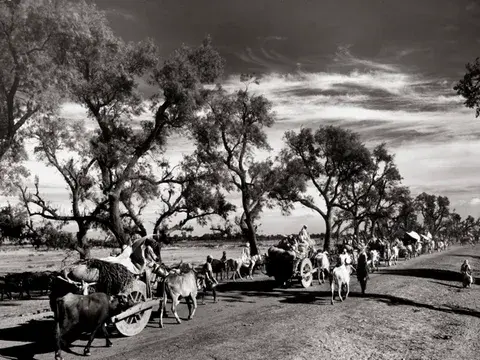
Children, too, suffered immensely. Refugee accounts speak of boys and girls separated from parents in the chaos of migration, many never reunited. Relief camps were filled with orphans who carried both visible and invisible wounds.
Yet, amid the horror, humanity persisted. In Amritsar, Sikh families hid Muslim neighbours in cellars. In Lahore, Muslim villagers escorted Hindu women to safety. These acts of courage and compassion, though less told, remind us that even in the darkest times, humanity can endure.
Census Stories: How Communities Disappeared

The Partition redrew not only borders but also the cultural and demographic fabric of South Asia. Census figures tell this silent story.

In Punjab, Muslims who once made up over 53% of the population in 1941 nearly vanished from Indian Punjab by 1951, reduced to less than 2%. On the Pakistani side, Hindus and Sikhs, who had formed almost 35% of the population, were reduced to a mere fraction. Towns that once thrived as shared spaces of culture and commerce became homogenous, stripped of their pluralistic soul.
Refugee camps sprang up in Delhi, Karachi, Lahore, and Calcutta. In Delhi alone, more than 470,000 refugees arrived between 1947 and 1951, reshaping the city’s very character. The government distributed land and homes, but often unevenly, creating resentment and hardship. Many families who lost businesses in Lahore or Karachi were never able to rebuild their economic standing in India.
Voices from the Other Side of Silence

For decades, Partition survivors rarely spoke of their trauma. Silence became their shield. Only in later years did these voices emerge.
Women recalled being forced onto trains by strangers or watching entire families vanish in the chaos. Men spoke of leaving behind ancestral homes built over generations. Children raised in refugee camps remembered both hunger and resilience, the constant struggle to fit into societies that treated them as outsiders.
These personal accounts reveal that Partition was not a single event but a lived experience that echoed across decades, shaping not only the first generation of survivors but their children and grandchildren.
The Politics of Memory

Partition did not end with the drawing of borders; it became the seed of future conflicts. Wars between India and Pakistan in 1947, 1965, and 1971 entrenched hostility. Families separated by the Radcliffe Line often remained divided for life, their ties cut by visa restrictions and politics.
The way Partition was remembered also became political. In India, the narrative often highlighted resilience, the challenge of absorbing millions of refugees, and the triumph of building a new democracy. In Pakistan, the story emphasised the struggle for a homeland where Muslims could live with dignity and autonomy. Yet, in both nations, the stories of ordinary people, of longing, of loss, of friendships destroyed by an arbitrary line, were often pushed aside in official histories.
Legacy and Lessons

More than 75 years later, the Partition continues to shape the region. The refugee colonies of Delhi and Lahore are now thriving neighbourhoods, but their residents still tell stories of the villages they left behind. For many families, identity remains tied to places they can no longer visit.
The trauma of Partition has even seeped into art, literature, and cinema. Works like The Other Side of Silence and The Great Partition have given voice to those once silenced. Writers and filmmakers continue to remind us that Partition was not just about borders but about human lives caught in their sweep.
The lessons remain urgent. Partition showed how dangerous communal hatred can be and how destructive rushed political decisions become when human lives are reduced to numbers on a map. At the same time, it highlighted the resilience of people, their ability to rebuild, adapt, and hope even after enduring unthinkable loss.
Remembering to Heal
Partition is more than a chapter in a history book; it is a living memory. Nearly every Indian and Pakistani family has a story connected to it: a grandmother who walked barefoot across the border, a father who rebuilt from nothing, a cousin lost forever.
Remembering these stories is not about reopening wounds but about honouring the resilience of those who endured them. The Partition was at once a moment of triumph and tragedy, the dawn of freedom and the breaking of hearts. Only by acknowledging both can South Asia begin to heal its oldest wound.

.png)
Comments